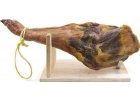
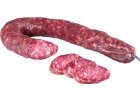
Hams and Sausages is a category of Spanish cured meats focused on dry-cured jamón hams and meat specialities made from Iberian as well as ordinary pork. The key distinguishing feature of jamón is the coloured label on the trotter - black and red indicate ibérico de bellota (hams from pigs fattened on acorns), while green and white indicate ibérico de cebo (feed based on cereals and pulses), whereas jamón serrano comes from a different breed and has no colour standard. Alongside whole bone-in hams weighing 7-9 kg, the category also offers packaged slices of 70-100 g for everyday consumption. The complementary range of cured meats consists of fuet, chorizo, lomo and coppa from the producers Joselito, Cecinas Pablo, Montesano and Can Company. For correct slicing and serving, the category also includes jamón stands and knives from SteelBlade and Jamotec.
How to find your way around this category
The range is divided into three groups. Jamón contains dry-cured hams - either whole bone-in pieces for those who enjoy hand slicing, or packaged slices for immediate consumption. Sausages and salami cover smaller cured meats to be eaten as they are: fuet, chorizo, lomo, coppa and salami made from beef and from pork. Accessories are aids for slicing and serving - stands, knives and mats to go under the jamón.
For a festive occasion or as a gift, a whole bone-in ham and a stand are the right choice; for everyday dining, packaged slices or smaller salami. The main guide with jamón is the colour of the label - it determines the proportion of Iberian blood and the method of fattening, and with it the price and the intensity of flavour.
Jamón - how to choose the right type
The Spanish quality standard (Real Decreto 4/2014) distinguishes Iberian hams by the colour of the label on the trotter - this indicates the proportion of the Iberian breed and the way the pigs were fattened. Jamón serrano is governed by a different standard and comes from a different breed, usually the white pig.
| Type |
Label |
Rearing and fattening |
Recommended use |
| Jamón Ibérico de Bellota |
Black (100 % ibérico) or red (50-75 % ibérico) |
Free-range grazing in the dehesa, final fattening on acorns during the montanera season |
Premium tasting, gift, festive occasions |
| Jamón Ibérico de Cebo |
White, green for the de campo variant |
Farm rearing, feed based on cereals and pulses, supplemented by an outdoor run in the case of de campo |
Regular consumption at a more favourable price |
| Jamón Serrano |
No ibérico colour standard - a different breed (typically the white pig) |
Rearing outside the Iberian standard, fattening on standard feed |
Everyday use, tapas, sandwiches |
Both the weight and the ageing time differ from one piece to another, because this is a natural product that ages under variable conditions. You will always find the specific weight and length of ageing in the description of the given product.
Sausages and salami - spicy and non-spicy cured meats
Alongside jamón, the category also offers smaller dry-cured meats intended to be eaten directly, without slicing a whole ham. Fuet is a thin dry-cured pork salami, chorizo is made with paprika and comes in both a spicy and a non-spicy version, lomo is dry-cured pork tenderloin and coppa comes from the neck. Beef variants (chorizo, salami) are offered by Cecinas Pablo for customers who prefer beef.
With chorizo, always check the spicy/non-spicy designation directly in the product name - the same brand commonly offers both variants.
Storing and serving jamón
A whole bone-in ham is stored hanging on a stand in a dry and cool place, out of direct sunlight, ideally at a room temperature of around 15-20 °C. After each slicing, the cut surface is covered with a slice of fat or a clean cotton cloth so that the meat does not dry out. Once opened, packaged slices belong in the fridge and should be consumed within the period stated by the producer on the packaging.
For correct slicing, a long narrow jamón knife and a stable stand (jamonero) that holds the ham firmly at the right angle are useful - you will find both in the Accessories subcategory.
Frequently asked questions
What is the difference between jamón ibérico and jamón serrano?
Jamón ibérico is made from the Iberian pig or its crossbreeds and is subject to the colour label standard (black, red, green, white). Jamón serrano comes from a different, usually white breed and is not governed by this standard - it is a more affordable variant with a different flavour.
What does the black label on jamón mean?
The black label (pata negra) designates 100% ibérico de bellota - a ham from pigs whose parents were both purebred Iberian pigs fattened exclusively on acorns during the montanera season.
How long does an opened jamón keep?
A whole ham that has been cut into will keep for several weeks if the cut surface is properly covered and it is stored somewhere dry and cool. Packaged slices have a shelf life stated on the packaging and belong in the fridge once opened.
How do you slice jamón correctly at home?
The ham is fixed into a stand (jamonero) with the trotter facing up or down depending on the type of slicing, and it is cut with a long narrow knife into thin slices along the grain. You will find stands and knives in the Accessories subcategory.
Is chorizo iberico always spicy?
No, chorizo is made in both a spicy and a non-spicy version, depending on the amount and type of paprika used. You can always tell which variant it is from the designation in the product name.
What is the difference between fuet and lomo?
Fuet is a thin dry-cured salami made from minced pork in a natural casing, whereas lomo is a whole piece of dry-cured pork tenderloin. Both are served cut into thin slices as a cold starter.
How should dry-cured salami be stored once opened?
Once unwrapped, it is advisable to wrap the salami in cling film or a cotton cloth and keep it in the fridge; the cut surface should not be left exposed to the air for any length of time, so that the meat does not dry out.
What does "de bellota" mean on jamón?
Bellota is the Spanish word for acorn. The designation "de bellota" means that in the final phase of fattening (montanera) the pigs were fed exclusively on acorns on free-range pasture, which gives the ham its typical nutty flavour.
Subcategories and related products
Jamón
Whole dry-cured hams and packaged slices, Ibérico and Serrano
Cheeses
To complete the tasting board
Good to know
What matters in practice
With jamón, the colour of the label and the proportion of Iberian blood; with salami, the meat ratio, the type of spices and the level of spiciness.
Also: both prices and flavour intensity rise with the proportion of bellota fattening.
What we base this on
On the Spanish quality standard for Iberian jamón (Real Decreto 4/2014) and on information from the producers Cinco Jotas, Jamones Blázquez, Montesano and Joselito.
Also: we verify the specific parameters with current deliveries.
Where the limits are
The exact weight and ageing time differ from one piece of ham to another; it is a natural product.
Also: you will always find the current parameters and availability in the detail of the specific product.
What this category does not cover
Fresh meat for cooking, nor cheeses for a tasting board.
Also: you will find cheeses in the Cheeses category and wine for pairing in the Wines and drinks category.